
A Yacht for Florida and the Carolinas
A practical guide to choosing for your home waters, coastal passages, and life aboard.
THE WATERLINE / REGIONAL PERSPECTIVES
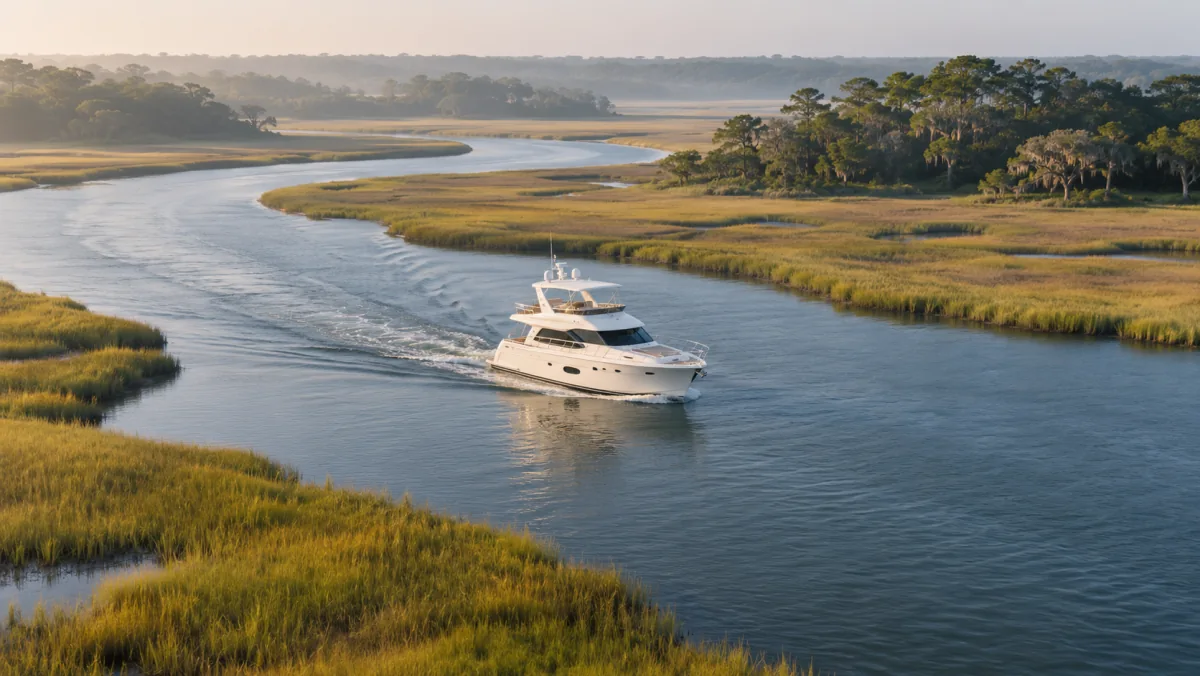
Coastal access, home berthing, and everyday comfort shape the regional yacht search. Editorial illustration.
A Saturday on the water might begin with coffee in Charleston and end with friends gathered around the aft deck. Another trip could involve an early departure from the North Carolina coast, a day offshore, or several weeks working south toward Palm Beach.
These are different versions of yacht ownership. The vessel that makes one effortless may ask for compromises on another.
The most useful starting point is a clear picture of your ordinary boating life: where you will keep the yacht, how often you will leave the dock, who will come with you, and how you feel about the time spent underway. A yacht should fit those habits as convincingly as it fits your ambitions.
Along Florida and the Carolinas, that means considering the entire journey, from the home berth to the destination and back again.
Begin with three trips you will actually take
Before comparing builders or lengths, describe three representative outings.
Your usual day aboard. You might leave a home dock for lunch, host family for an afternoon, or head offshore to fish. Think through boarding, shade, refrigeration, seating, gear, swimming access, and the work required to depart and return. A yacht that is convenient for the people operating it is easier to use spontaneously.
Your normal overnight trip. Imagine the guests you realistically expect, their sleeping arrangements, and the privacy everyone needs. Check whether a cabin remains comfortable with luggage aboard and whether someone can use a bathroom without disturbing another guest. The difference between a nominal berth and a room an adult enjoys can be substantial.
Your longer seasonal passage. Consider successive days aboard, provisioning, weather delays, laundry, machinery checks, and a change of destination. If professional crew will handle deliveries, distinguish their working requirements from your own experience as a guest.
Give each scenario a rough share of your intended use. This is a way to keep an occasional dream trip from dominating every purchase decision. The most successful compromise is one you understand before buying.
Understand the coastline at the scale of your route
North Carolina and South Carolina
The Carolinas combine ocean approaches with rivers, sounds, inlets, and coastal waterways. NOAA's Coast Pilot describes North Carolina's barrier islands and extensive sounds, followed farther south by the barrier islands and coastal entrances of South Carolina. It also highlights changing inlet channels and the importance of local conditions. [1]
For buyers, the implication is practical: being suitable for a major harbor does not establish that a yacht can comfortably reach a particular private dock, marina, or creek-side destination.
A Wilmington-based owner planning regular offshore fishing might place deck movement, cockpit function, helm protection, and machinery access high on the list. An owner using Charleston as a base for weekends with friends may care more about easy boarding, shaded dining, and cabins that work for actual guests. Either owner could have reasons to choose a different arrangement. The location is a starting point for questions, not a specification by itself.
Florida
The same discipline applies in Florida. A Palm Beach itinerary built around short outings and entertaining asks different things of a yacht than repeated coastal passages, extended stays aboard, or trips involving the Keys and Gulf coast.
Decide how much time you expect to spend inside waterways and how much offshore. Some owners value an enclosed helm for longer passages; others spend most of their leisure time outside and prioritize shade, seating, and easy movement between the cockpit and saloon.
Florida's manatee protection rules can restrict vessel speed, operation, or access in designated areas. [2] A yacht's maximum speed therefore tells you little about the time required for every local outing. Review the intended route and current restrictions before deciding that faster machinery will make your usual journey substantially shorter.
Check the dimensions that control everyday access
Length is only one part of the fit. Ask for a documented set of dimensions in the yacht's relevant operating condition, and compare them with the places you actually intend to use.
Draft and loading. Confirm what the published draft includes and how it relates to fuel, water, equipment, provisions, and other loads aboard. Then have the intended routes assessed with an appropriate margin beneath the vessel. The goal is to understand the limitations of that particular yacht; a single draft figure cannot establish access throughout a region.
Height above the water. Towers, antennas, radar equipment, and other structures belong in the air-draft conversation. If something can lower, establish the resulting height and what the procedure involves. Check bridge clearances and opening arrangements for the specific route and relevant water level. An arrangement that requires substantial preparation at every outing may be less convenient than it first appears.
Beam and usable berth space. A berth must accommodate more than the yacht's nominal width. Ask the marina to assess the particular vessel, including fenders, access, maneuvering room, and any boarding arrangement. A wide yacht may offer generous interior space while narrowing the list of suitable slips.
Overall length in the relevant configuration. Confirm how the marina measures the vessel, including platforms, bowsprits, or other projections where applicable. Check where the tender will live and whether its storage arrangement changes practical dock access.
NOAA's Coast Pilot covers subjects including bridge clearances, channels, currents, water levels, and small-craft facilities. [3] Use those resources alongside current charts and appropriately qualified local advice to investigate a route. A listing's dimensions are a starting point for that work, not a route clearance.
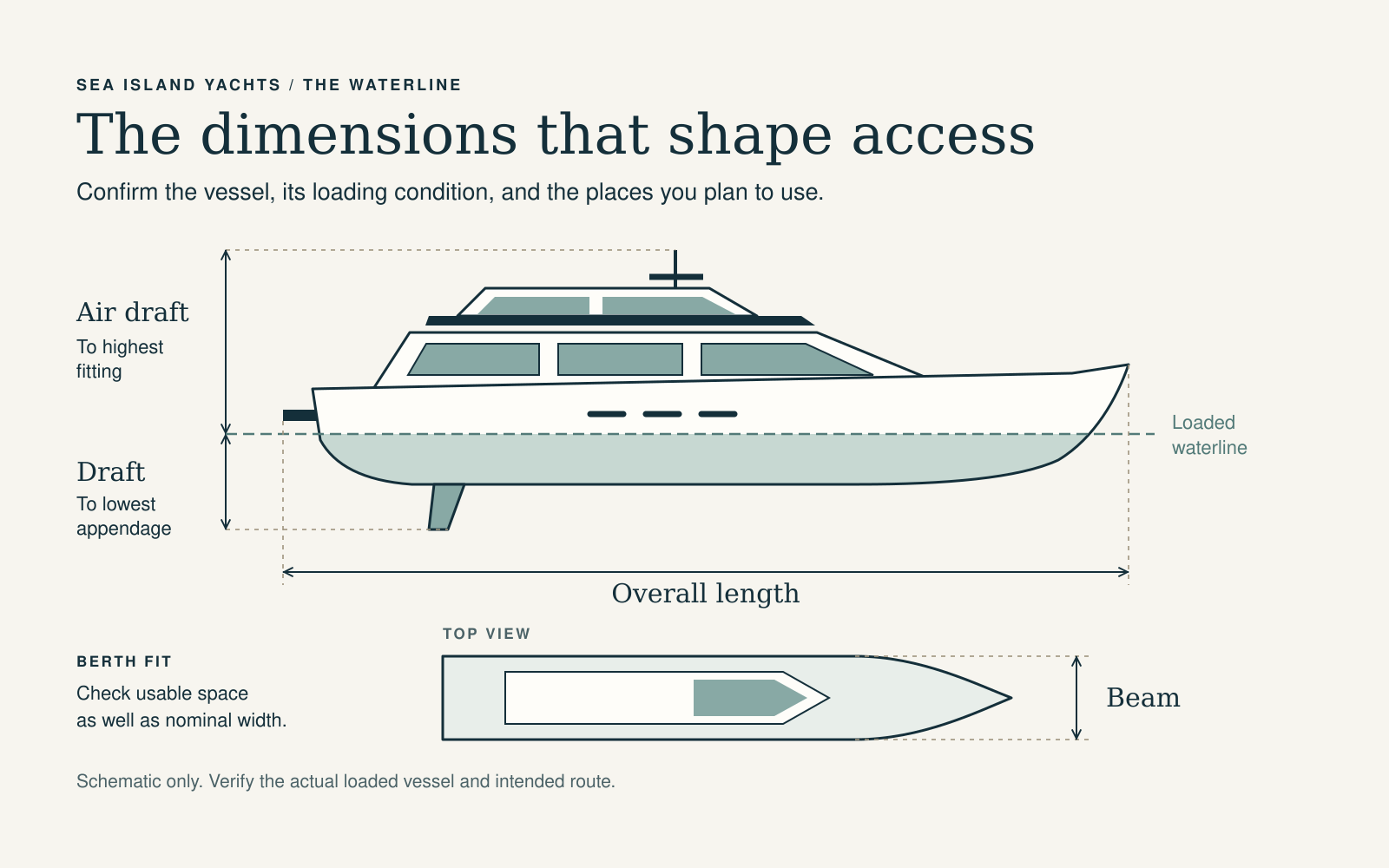
Check the actual yacht in its relevant loaded condition: air draft, draft, overall length and beam each shape access and berth suitability.
Compare a realistic passage day
Ask what the yacht can do at the speed you expect to use, with a representative load aboard.
Published range and performance figures need context. Request the conditions behind them: loading, operating speed, machinery, fuel assumptions, and whether onboard demands such as air conditioning and refrigeration are included. Then ask the captain or technical adviser to assess the intended passage with sensible reserves and alternatives.
This is especially useful when comparing yachts with different operating profiles. A vessel that feels appealing at a slow cruise may suit an owner who enjoys the journey. Another owner may value a faster passage when conditions allow. Evaluate fuel use, noise, motion, and comfort at the relevant speeds rather than judging by the fastest number in a brochure.
Include the parts of the day outside open-water cruising: bridge arrangements, restricted-speed sections, fueling, docking, and preparation. A theoretical travel-time advantage can become modest once the whole outing is considered.
For longer trips, decide how much flexibility your calendar allows. A purchase should not depend on being able to make a particular passage on a particular day regardless of conditions.
Look closely at comfort while moving and at rest
A walk-through shows the yacht in one state. Ownership involves several.
Spend time at the helm, in the main seating areas, and in the cabins during a properly arranged sea trial. Pay attention to visibility, conversation, vibration, access to handholds, and the ease of moving between spaces. Ask how the intended guests will manage steps and changes in level while underway.
If stabilization matters, clarify the installed system's capabilities, operating requirements, and maintenance needs. Ask specifically about the conditions in which you expect to use it, including time at anchor. The presence of a system name on an equipment list does not answer all those questions.
Also consider a warm afternoon with the yacht occupied. Can everyone find shade? Does the layout offer a comfortable place to retreat indoors? Is there a sensible route for wet guests and equipment? What systems need to run to provide the comfort you expect away from shore power?
These details give luxury its practical meaning. They shape how relaxed life aboard feels after the first impression has passed.
Choose the berth and support arrangements early
The home berth should be part of the search from the beginning.
Ask about availability for the actual vessel, electrical service, water, boarding arrangements, parking, visitor access, and operating policies. Consider the distance from home and the time required to prepare the yacht. A beautiful location may still be inconvenient for frequent use.
Then identify who will care for it between trips. An owner-operated yacht still needs a clear arrangement for inspections, routine service, cleaning, and responding when something needs attention. If crew are involved, establish responsibilities and the level of availability you expect.
For each serious candidate, discuss the machinery and equipment with relevant service providers. Can the yacht be hauled locally? Can its major components be serviced? Is there reasonable access to the equipment that requires regular attention? Ask for estimates tied to the actual vessel and scope of work.
The annual budget should reflect these choices, with separate allowances for predictable operating costs, scheduled maintenance, and work identified during inspection. A generic percentage of purchase price cannot describe every ownership situation well.
Use inspection and sea trial to answer your own questions
For a pre-owned yacht, appoint qualified independent professionals for the survey, machinery inspections, and other investigations appropriate to the vessel. Agree the scope before the visit and distinguish your lifestyle observations from the technical conclusions those specialists provide. For a new yacht, establish a commissioning and acceptance process that tests the same intended-use requirements before handover.
Bring a short set of owner questions aboard:
- Can the people who will operate the yacht see, communicate, and move comfortably during docking?
- Are the side decks, boarding points, and regularly used steps workable for the intended guests?
- Does the helm remain comfortable at the cruise setting you expect to use?
- Can normal provisions, luggage, and activity equipment fit without turning living areas into storage?
- Can routine checks be performed without dismantling part of the interior?
- What repairs, service, training, or equipment changes would be needed before your first season?
A trial is a sample of performance in the conditions encountered. Use the findings to refine questions and obtain specialist advice; do not treat one pleasant outing as proof of suitability in every situation.
Make weather and insurance part of the ownership plan
The Atlantic hurricane season officially runs from June 1 through November 30. [4] Before completing a purchase, establish an achievable storm plan with the people who will carry it out and discuss it with the insurer and marina.
Ask who monitors the yacht when you are away, who has authority to move or secure it, what preparation resources are available, and what happens if the preferred berth or haul-out option is unavailable. Confirm any policy conditions relevant to navigation, seasonal location, crew, or storm preparation with the insurer. Those terms belong to the actual policy and vessel.
Current information matters outside hurricane season as well. The Coast Guard's Local Notices to Mariners are a resource for recent navigation information. [5] Make reviewing current notices and relevant local information part of trip planning, especially after events that may have changed a waterway.
Your regional yacht checklist
Before turning a long list into a shortlist, confirm:
- Primary home berth and the destinations you expect to visit most often.
- Relevant draft, bridge, berth, and access constraints for those locations.
- Typical trip length, guest group, and time spent offshore.
- Acceptable travel time and flexibility when plans need to change.
- The spaces and activities that matter on an ordinary day aboard.
- Owner and crew responsibilities, including training and delivery plans.
- Inspection findings and work needed to make the yacht ready for your use.
- Berthing, service, insurance, and storm arrangements for the actual vessel.
You do not need to resolve every point before beginning a conversation. It helps to know which answers are essential and which preferences can evolve.
Questions buyers often ask
Can one yacht work well in both Florida and the Carolinas
Yes, provided the particular vessel suits the routes, berths, operating arrangements, and conditions you intend to encounter. Begin with the most restrictive regular requirement, then compare the compromises it creates elsewhere. Being comfortable in one home port does not establish suitability for every stop along the coast.
Should I choose the shallowest draft available
Draft is one important constraint among several. First establish what your intended destinations require, then compare otherwise suitable yachts for comfort, handling, accommodations, service needs, and overall ownership fit. Avoid allowing one favorable dimension to substitute for a complete assessment.
Is a larger yacht automatically a better regional cruiser
Additional space can be valuable, but it may also change berthing options, operating responsibilities, and maintenance requirements. The better choice is the yacht whose usable space and capabilities improve your actual trips enough to justify those obligations. Assess the people and work involved as carefully as the accommodation plan.
The Sea Island perspective
Start with the places you want to go and the days you expect to enjoy. Bring your home-port plans, usual guest group, and a few representative trips to the first buying conversation.
With those details in view, the search becomes more specific. You can judge each yacht against a life you can picture, and ask better questions before committing to it.
Discuss your cruising plans with Sea Island Yachts.
This guide supports yacht selection. Route planning and vessel suitability require current information and appropriately qualified advice for the particular vessel and conditions.
Sources and further reading
Sources checked November 4, 2026.
NOAA Office of Coast Survey. United States Coast Pilot 4, Chapter 3, Cape Henry to Key West. https://nauticalcharts.noaa.gov/publications/coast-pilot/files/cp4/CPB4_C03_WEB.pdf
Florida Fish and Wildlife Conservation Commission. Manatee Protection Zones. https://myfwc.com/boating/waterway/markers/manatee-protection-zone/
NOAA Office of Coast Survey. United States Coast Pilot. https://nauticalcharts.noaa.gov/publications/coast-pilot/index.html
NOAA. Prepare Before Hurricane Season. https://www.noaa.gov/prepare-before-hurricane-season
U.S. Coast Guard Navigation Center. Local Notices to Mariners by Coast Guard District. https://navcen.uscg.gov/local-notices-to-mariners-by-cg-district