
Your First Custom Yacht Brief
Before the first drawing, there should be a conversation about the life you want aboard.
THE WATERLINE / CUSTOM YACHTS
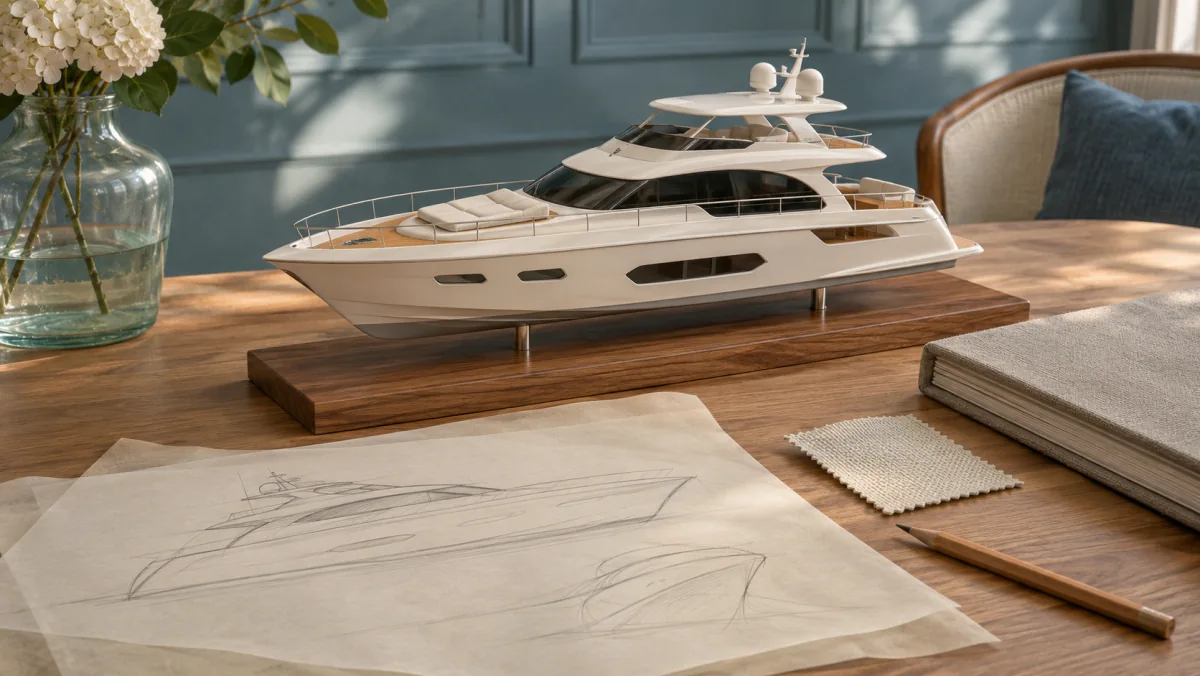
An owner’s brief connects ideas about life aboard with the decisions a project will require. Editorial illustration.
A custom yacht often begins with a scene rather than a specification: breakfast in the shade, a cockpit arranged around fishing, or a week in the islands with room for the people you most enjoy having aboard.
Those ideas are valuable. They explain why you want to build. The next step is to describe them clearly enough that a designer and builder can understand what the yacht must deliver, where compromises are acceptable, and which questions still need investigation.
That is the purpose of an owner's brief. It connects the experience you imagine with the decisions a project will require.
You do not need to arrive with drawings, engineering answers, or a fixed choice of shipyard. A useful first brief can be short. Its strength comes from the quality of its priorities.
Begin with an ordinary trip
Describe the trip you expect to take most often. Where will you leave from? Who will join you? How many nights will you spend aboard? Will you move every day, stay in marinas, or spend several nights at anchor?
Then describe a second, more demanding trip that the yacht should reasonably accommodate. For a southeastern owner, that might mean frequent weekends along the Carolinas, with occasional longer stays in Florida or the Bahamas. The distinction helps prevent an occasional ambition from dominating every part of the design.
Consider what happens throughout the day. A family may need easy movement between cabins, a shaded social space, and a comfortable way to board the tender. An owner who fishes regularly may place greater value on cockpit circulation, equipment storage, visibility, and cleaning arrangements.
Write these activities down before selecting equipment. Naval architect Michael Kasten describes the owner's initial specification as a statement of intended use and design goals, with detailed solutions developing through the design process. [1]
Give each requirement a clear priority
A list becomes more useful when its items carry different weight. Divide your ideas into three categories:
- Essential: The yacht would not suit your ownership plans without this requirement.
- Preferred: Valuable enough to influence the design, but open to compromise.
- Open for guidance: A question you want the project team to investigate.
Comfortable overnight accommodation for six people might be essential. A separate guest entrance might be preferred. Whether those accommodations require a particular length could remain open.
Explain the reason behind each essential. If a low draft matters because you want to use a particular berth, identify that constraint. If quiet cabins matter because children sleep while others entertain, describe the situation. The team can then explore several solutions rather than working toward one prematurely fixed answer.
Limit the list of essentials. If every feature is indispensable, the brief offers little help when two requirements compete.
Understand where the compromises live
Draft, range, speed, payload, and accommodation are connected. An additional cabin, larger tender, or expanded fuel capacity occupies space and adds weight. More equipment also brings installation, power, maintenance, and service-access requirements.
A request for greater speed deserves a conversation about the operating speed you will actually use. A range target needs a defined loading condition, speed, and reserve policy before it can become a meaningful design requirement.
Similarly, shallow-water access should be discussed in terms of the yacht's relevant loaded condition and the places you intend to visit. An attractive draft figure by itself does not establish access to a particular route or anchorage.
Your brief should make the tradeoff visible: would you accept less top speed for greater endurance, a different interior arrangement to improve machinery access, or a smaller tender to simplify handling? These are questions for a design study, not conclusions to settle from a brochure.
Design for the people operating the yacht
Identify who will handle the yacht and how that arrangement might change. Owner operation, regular professional crew, and occasional delivery assistance create different practical needs.
Walk through docking, anchoring, watchkeeping, provisioning, cleaning, and overnight guest service. Where does someone stand to handle a line? Can supplies reach their storage without crossing the main entertaining area? Can routine maintenance take place without dismantling a guest space?
When crew are involved, consider accommodation, privacy, work areas, and circulation early. Invite an experienced captain or operator to review the arrangement at an appropriate stage. A person who will run the yacht can reveal problems that are difficult to recognize in a presentation drawing.
State whether use will be private, commercial, or undecided. Ask the project advisers to establish the applicable requirements before the design becomes difficult to change.
Choose the right amount of customization
Three starting points deserve consideration.
A production yacht with selected options may already satisfy the important requirements. The question is whether the available equipment, arrangement, and delivery opportunity suit your brief.
A semi-custom yacht begins with an established platform and offers a defined scope of personalization. Heesen, for example, describes its platform approach as combining shared engineering and hull forms with owner choices in interior outfitting and finishes. That illustrates one approach; another builder's permitted changes may be quite different. [2]
A full-custom yacht allows a broader design exercise when existing platforms cannot reasonably deliver the required arrangement or capabilities. It also requires clarity about who develops, checks, and approves the design.
Ask each builder to identify what is fixed, what can change, when decisions are required, and how changes affect the proposal. A label such as “custom” is less useful than a written explanation of the actual freedom available.
Bring the less visible details into the brief
A considered interior is supported by systems that work comfortably in the background. Discuss cabin noise, vibration, ventilation, climate control, lighting, refrigeration, storage, connectivity, and the way the yacht will function at anchor.
Express the desired experience first. “We want to sleep comfortably while normal overnight systems operate” is a useful starting requirement. The technical team can then define suitable equipment, design targets, and methods of verification.
Give the tender similar attention. Describe who will use it, what it must carry, and how often it will launch. Ask how it will be stored, fueled or charged, boarded, and retrieved. A tender that looks ideal in isolation may create awkward demands on the yacht carrying it.
Serviceability deserves its own discussion. Ask how major components will be reached and eventually removed, which maintenance jobs require specialist attendance, and what support is available in your intended cruising region. Space reserved for service access can be as valuable as space reserved for display.
Establish the full project boundary
Give the team an initial investment range and identify what that range is intended to include. A construction price and a yacht ready for its first season may represent different scopes.
Build a working budget around design and engineering, construction, professional advice and representation, inspections, owner-supplied equipment, commissioning, delivery, documentation, applicable taxes, and initial outfitting. Include items such as the tender, spare parts, and crew preparation wherever relevant to the project.
Separate confirmed inclusions from allowances, optional choices, and unresolved costs. Set contingency with the advisers around the project's actual uncertainties; a universal percentage cannot explain the risk of every design or contract.
Treat the delivery date with similar care. Distinguish a preferred handover period from a genuinely immovable commitment. Ask how design approvals, equipment availability, construction, trials, and correction of outstanding work fit together. Plan time after handover for familiarization and preparation before a demanding first voyage.
Decide who is responsible for each decision
A build involves several roles that should be defined in writing. The builder's responsibilities arise from the construction agreement. Naval architects and engineers develop and assess the technical design within their appointments. Designers address the spaces and appearance included in their scope. An owner's representative coordinates the owner's interests under a separate agreed mandate.
Independent surveyors and specialist inspectors may assess defined aspects of construction or acceptance. Legal advisers address the contract and its protections. Where classification applies, the classification society reviews compliance within its rules and agreed scope; RINA's published process includes plan approval, construction surveillance, and attendance at sea trials. [3]
These roles should fit together without leaving gaps. A class certificate, for example, does not answer whether the dining arrangement meets your family's needs. DNV's discussion of yacht newbuilding emphasizes early feasibility work and involvement from technical, legal, operational, class, and flag-state participants as appropriate to the project. [4]
Designate one person authorized to consolidate owner feedback and approve decisions. This helps prevent contradictory instructions from reaching the yard.
Make changes and acceptance specific
A change request should describe more than the new feature. Ask the team to record its effect on price, weight, systems, schedule, and earlier approvals before authorizing it. Keep the accepted specification current so that everyone works from the same version.
Before construction commitments are finalized, agree how important requirements will be demonstrated. “Quiet,” “long range,” and “easy tender handling” are useful aspirations, but they need defined acceptance methods if they are to become contractual obligations.
Those methods might involve documented measurements, dockside demonstrations, and sea trials under agreed conditions. The relevant specialists should help set the criteria, identify who witnesses them, and establish how deficiencies will be recorded and resolved.
Include the handover itself: operating information, equipment records, training, spare parts, warranty contacts, and responsibility for remaining work. Launch is a memorable milestone. A well-prepared handover is what helps you begin using the yacht with confidence.
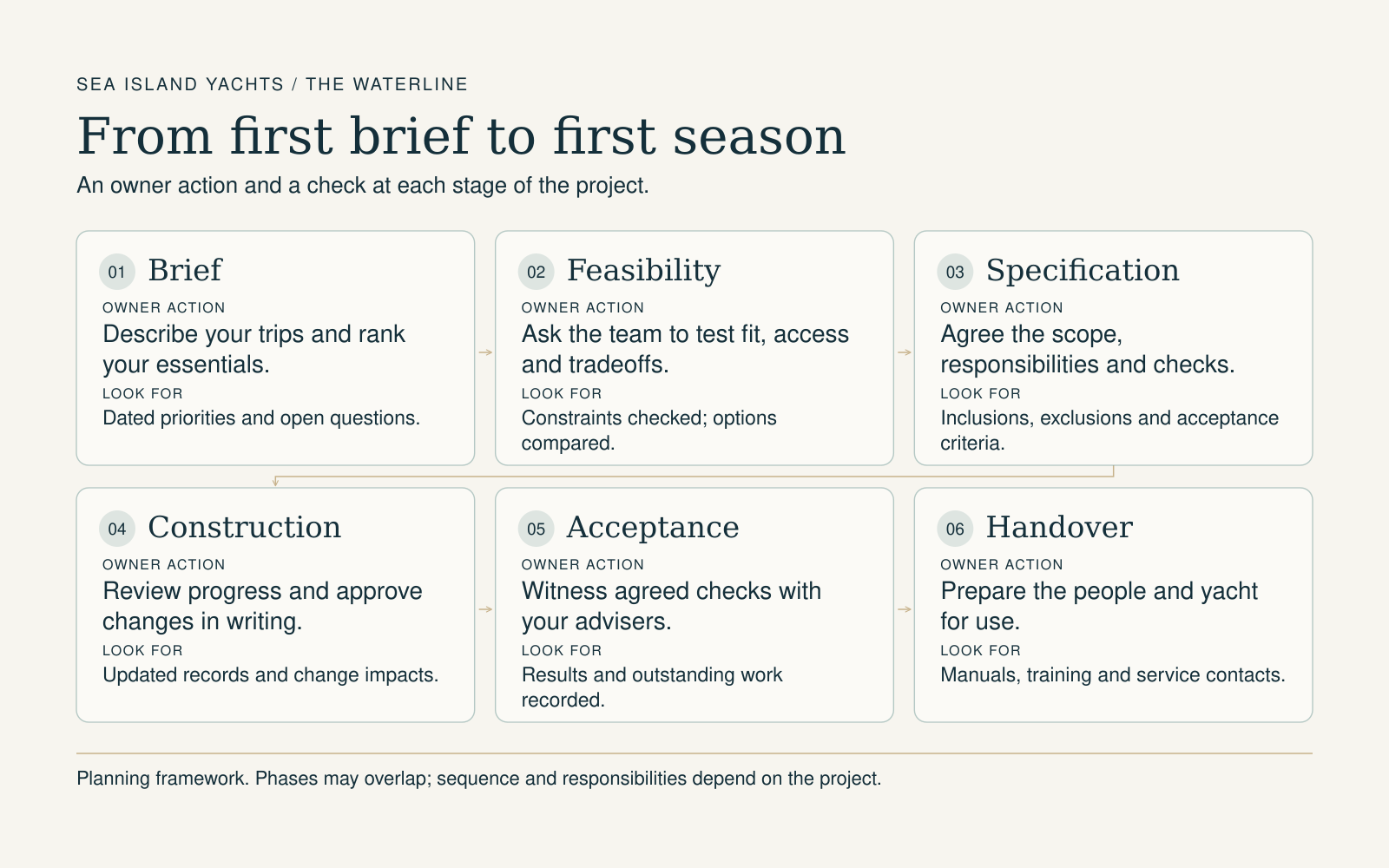
Use these phases as a planning framework. Sequence, responsibilities, evidence and approvals should reflect the particular yacht, appointed advisers and project agreements.
A first brief in practice
The following is a hypothetical starting brief:
We expect to cruise primarily between the Carolinas and Florida, with occasional Bahamas trips when conditions suit. Most trips will involve four adults, with accommodation for six essential. Shaded outdoor dining and comfortable nights at anchor take priority over maximum speed. We are open on length and styling, but our intended home berth must be checked before a platform is selected. We would like professional guidance on operating arrangements, tender handling, and the equipment needed for time away from marinas. Our budget should cover delivery and preparation for the first season.
This does not specify a finished yacht. It gives the team enough direction to ask useful questions, compare approaches, and test whether the requirements belong together.
Your first custom yacht worksheet
Use the prompts below before meeting a broker, designer, or builder. Leave uncertain answers open and mark assumptions that need verification. You can describe functional needs without including personal documents or sensitive financial records.
Your cruising life
Primary cruising region and preferred home port: ______________________________
Typical trip length and time spent at anchor or in marinas: ______________________________
A less frequent trip the yacht should also support: ______________________________
Main activities: Family cruising / Entertaining / Fishing / Extended passages / Exploring / Other
Intended use: Private / Commercial / Undecided
People and accommodations
Typical guests aboard: ______ Maximum overnight guests: ______
Preferred number of guest cabins: ______
Operating plan: Owner operated / Professional crew / Mixed arrangement / Undecided
Spaces, privacy, boarding, or movement needs that matter most: ______________________________
Who should contribute to the brief: ______________________________
Performance and access
Rank your priorities: Cruising efficiency / Speed / Shallow-water access / Comfort / Storage
Known berth, length, beam, draft, or height constraints: ______________________________
Which constraints still need verification: ______________________________
Expected time between fuel, water, or provisioning stops: ______________________________
Tender use and typical passengers or equipment: ______________________________
Design and lifestyle
Three essentials and the reason for each:
Three preferences you would consider trading against cost or complexity:
Existing yachts or design references you admire and why: ______________________________
An arrangement or ownership frustration you want to avoid: ______________________________
Project boundaries
Initial total project investment range and what it includes: ______________________________
Desired delivery period and degree of flexibility: ______________________________
Starting point: Production with options / Semi-custom / Full-custom / Open to guidance
Preferred level of involvement: Major decisions only / Regular design reviews / Closely involved
Person who will consolidate decisions: ______________________________
Three questions requiring professional investigation: ______________________________
Your vision
Describe the experience that would make this yacht feel your own:
Brief date and next review point: ______________________________
What happens after the brief
The next useful step is a feasibility conversation. Review conflicting priorities, verify access constraints, compare suitable platforms, and identify the specialists needed for the project. Update the brief as those questions are resolved.
From there, the team can develop an outline specification and seek comparable proposals. Read each proposal against the same requirements, including exclusions and responsibilities. An attractive presentation becomes more meaningful when you understand what is included and how the result will be verified.
The first brief remains a planning document. It becomes a sound foundation for later technical and contractual work when its assumptions are visible and its priorities are clear.
Begin with Sea Island Yachts
Bring your cruising plans, your essentials, and the questions you have not yet answered. Start a conversation with Sea Island Yachts about the ownership experience you want and which options merit further investigation.
This guide and worksheet support preliminary planning. Project feasibility, specifications, contracts, and acceptance arrangements require advice from the appropriately appointed marine, technical, and legal professionals.
Sources and further reading
Sources checked November 4, 2026.
- Kasten Marine Design, Our Custom Yacht Design Process. https://www.kastenmarine.com/custom.htm
- Heesen Yachts, Platform Concept. https://www.heesenyachts.com/platform-concept/
- RINA, New Building Ship Classification. https://www.rina.org/en/new-building
- DNV, Balancing Expectations in Yacht Management and Newbuilding Projects. https://www.dnv.com/expert-story/maritime-impact/Balancing-expectations-in-yacht-management-and-newbuilding-projects/