
Buying with the Bahamas in Mind
A yacht chosen for the crossing and the days you want to spend among the islands.
THE WATERLINE / ISLAND CRUISING
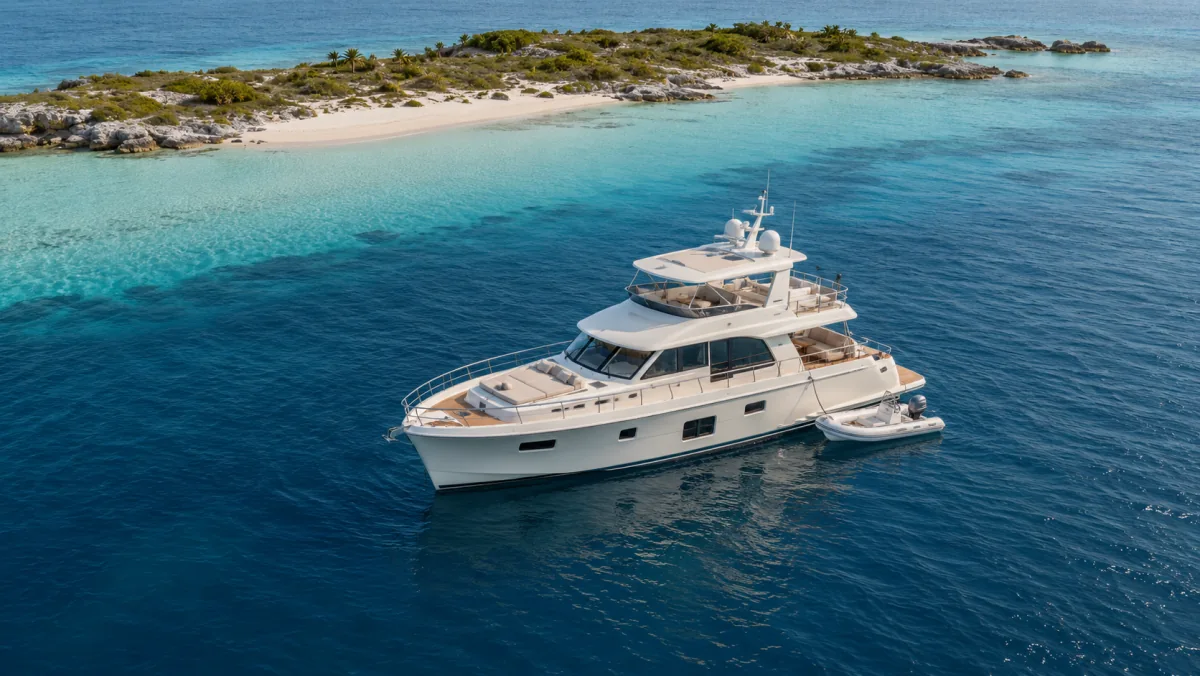
A Bahamas-oriented purchase should account for the crossing and life among the islands. Editorial illustration.
The Bahamas can change the way an owner thinks about a yacht. A tender becomes the connection to a quiet beach. Shade becomes somewhere to spend an entire afternoon. Refrigeration, fresh water, and a comfortable night's sleep begin to matter as much as the view from the flybridge.
From Florida, the islands can feel wonderfully close. Choosing a yacht for them still requires a broader perspective than the distance to the first landfall.
The right purchase should support three experiences: the passage across open water, movement among the destinations you hope to visit, and everyday life aboard once you arrive. A yacht that handles one beautifully may need compromises or improvements elsewhere.
Start by picturing the trip you would actually take. That picture will make the shortlist more useful.
Describe your Bahamas before choosing the yacht
An itinerary centered on marina stays asks different things of a vessel from one built around extended time at anchor. Neither is a lesser version of island cruising. They simply create different ownership priorities.
Imagine three possible trips. In the first, you travel to an established destination, spend several nights in a marina, and explore from there. In the second, you move between islands, alternating shoreside services with anchorages. In the third, you spend much of the visit away from full-service facilities, fishing, swimming, and exploring by tender.
For the first owner, easy docking, comfortable accommodations, and compatibility with the intended berth may dominate. The second needs a practical balance of passage performance, access, and independence. The third should examine storage, water, energy, equipment reliability, and the ability to remain comfortable when resupply is delayed.
Write down a few representative places in the Abacos, Exumas, or other island groups, then describe what you want to do there. Have a qualified captain assess the suitability of those destinations for each candidate yacht. A list of islands alone is less informative than knowing whether you plan to stay ashore for dinner, run the tender daily, or remain aboard for several uninterrupted days.
Understand the yacht at its cruising weight
Draft deserves attention early, but the number in a listing needs context. Ask whether it represents the actual vessel, how it was measured, and the loading condition behind it. Fuel, water, provisions, guests, equipment, and a tender all belong in the assessment of how the yacht will be used.
Have the vessel's lowest relevant underwater point identified. Then review representative approaches and berths using current charts, local information, and an appropriate under-keel margin. Charted depth, tide, sea conditions, and uncertainty in the information all need to be considered together. This article cannot turn a published draft into an assurance of access.
Shallower draft can broaden a shortlist of possible destinations. It does not establish offshore capability, comfort, or the suitability of the propulsion arrangement. Equally, a deeper-draft yacht can fit an itinerary planned around suitable waters and facilities.
Beam matters too. Confirm berth availability and physical fit with the actual marina rather than assuming that a space advertised for a certain length will suit every yacht of that length. If the tender is part of your shallow-water plan, assess where the larger yacht can wait comfortably and how people will transfer between the two.
Assess the crossing as its own experience
The crossing from Florida deserves a separate conversation from the island itinerary. Ask how the yacht behaves at the speed you expect to use, with the load you expect to carry, and with the people who will normally be aboard.
The National Weather Service notes that wave-current interaction, including in the Gulf Stream, can significantly affect wave heights. Conditions at a sheltered departure point therefore do not describe the entire passage. Review current marine forecasts and professional passage advice for the whole intended operating area. [1]
During the sea trial, pay attention to helm visibility, seating support, movement through the accommodation spaces, noise, and the ability to communicate. Ask the surveyor and captain what the trial did and did not demonstrate. A short run in favorable conditions provides limited evidence about behavior in other conditions.
Speed may be useful, but a purchase should also make sense when slowing down is necessary. Discuss alternative destinations, departure flexibility, and a delayed return. A work commitment or guest flight should not become the reason to force a crossing that the captain considers unsuitable.
Turn advertised range into a usable operating plan
A brochure range figure becomes meaningful only when its assumptions are understood. Ask for the speed, fuel consumption, loading, sea conditions, and fuel allowance used to produce it. Where possible, compare those assumptions with records and observations from the individual yacht.
A purchase evaluation should consider the full intended sequence: the crossing, local movement, time at anchor, a possible diversion, and the return. If the generator draws from the propulsion fuel supply, include that consumption. A yacht can spend days stationary while still using fuel to support life aboard.
Have a qualified captain develop a vessel-specific fuel plan with suitable reserves. Do not assume every gallon in a tank is usable, every planned fuel stop will be available when needed, or an economy-speed range claim applies at a much faster cruising speed.
The useful question is not simply whether the yacht can reach an island. It is whether the operating plan leaves reasonable options when the itinerary changes. For an owner who prefers longer stays, that flexibility can matter more than an impressive top speed.
Treat the tender as part of the yacht
A tender often shapes the daily experience more than its modest share of the purchase price suggests. Consider the passengers who will use it, their mobility, the supplies it must carry, and the places you hope to reach.
Watch an actual launch and recovery demonstration. Ask who performs each task, where passengers wait, and how boarding works when the yacht and tender are moving differently. Confirm the lifting equipment's capacity against the tender's actual loaded weight and approved handling arrangement.
A large tender may offer comfort and carrying capacity while consuming deck space or requiring more involved handling. A lighter one may be easier to manage but offer less room for guests and supplies. Check seating, handholds, boarding access, storage, and the practical arrangement for carrying fuel.
For an owner who expects to operate with limited crew, a manageable routine is valuable. A tender that feels effortless only with extra hands may change how often you choose to go ashore.
Make a day at anchor part of the inspection
A yacht's interior is often shown with shore power connected, air conditioning running, and comparatively little demand on its systems. Ask how the same spaces function during an ordinary day at anchor.
Consider simultaneous loads: cooling occupied cabins, refrigeration, cooking, charging devices, and operating a watermaker if fitted. Have the relevant professionals review the electrical installation, battery condition, generator requirements, and the expected operating routine. Establish which services can run together and which require active management.
For a watermaker, ask to see operation, maintenance records, consumable requirements, and measured production under the conditions of the demonstration. Plan fresh-water storage and consumption for an interruption as well as normal operation. The presence of a machine is different from demonstrated, dependable capacity.
Then assess comfort without concentrating on machinery. Is there useful shade where people will actually sit? Can wet towels and equipment dry without taking over the saloon? Is swim access manageable for your guests? Can someone prepare lunch while others move through the same area?
If stabilization is fitted, ask specifically about its intended operation at anchor, its power requirements, and its limitations. Demonstrate the installed system where practicable. A reference to stabilization in a listing does not tell you how it will affect the experience you have in mind.
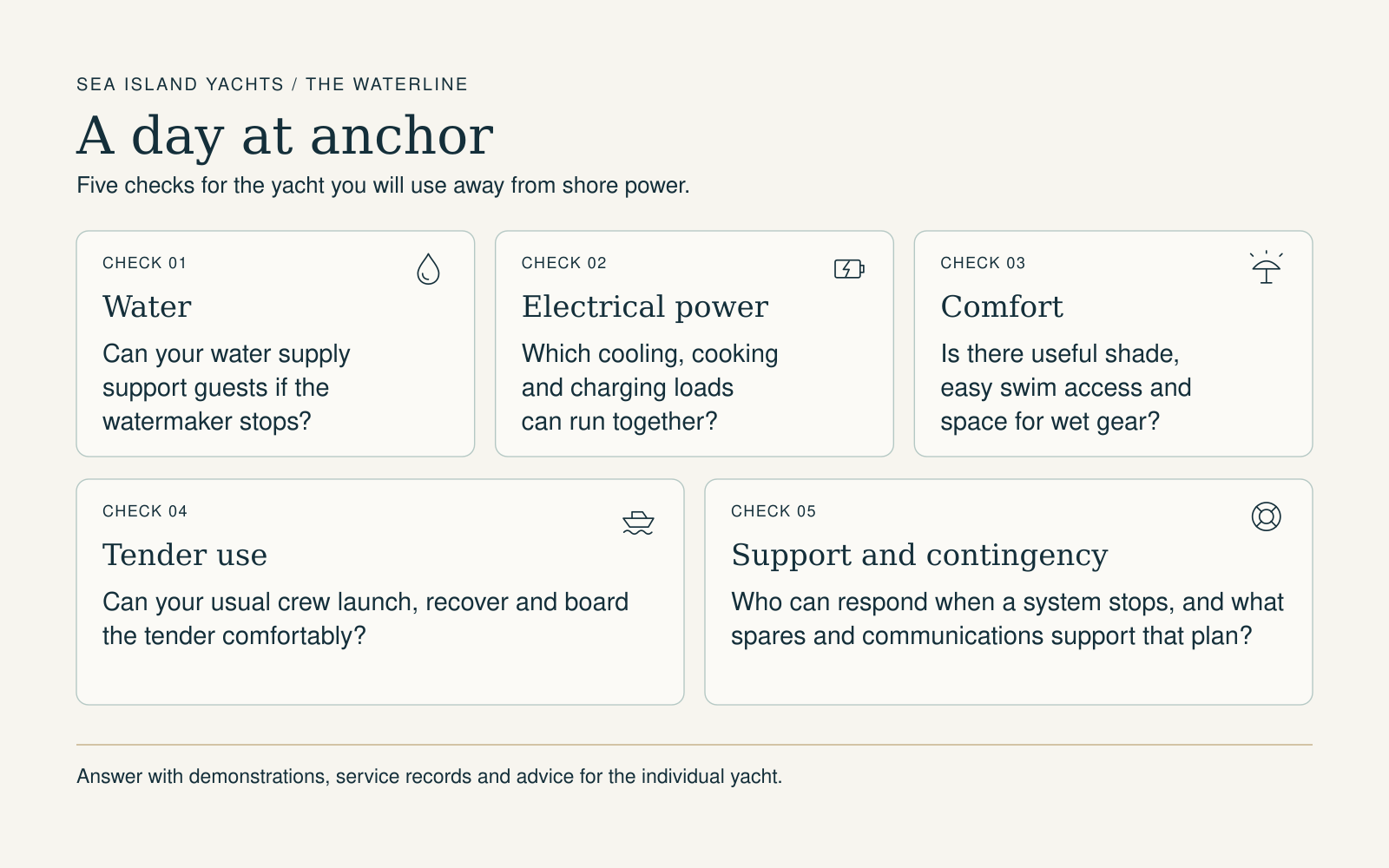
A day at anchor is a useful buying test. Review water, power, comfort, tender handling and the response to interrupted services for the individual yacht.
Look for a practical response to ordinary problems
Before buying, ask what happens if a routinely used system becomes unavailable during a trip. This is a useful way to assess service access and operational flexibility.
Can a technician reach the equipment without dismantling much of the interior? Are maintenance records, manuals, and parts information available? Which spares are appropriate for the specific machinery and itinerary? Who aboard can diagnose a problem, and when would outside assistance be required?
Discuss communications for the intended operating area and identify which services depend on subscriptions, coverage, or electrical power. An entertainment connection and an appropriate emergency communications plan serve different purposes.
Arrange equipment familiarization before the first island trip. The person operating the yacht should understand its ordinary checks, alarms, limitations, and maintenance routines. Reliable ownership depends partly on the vessel and partly on the ability to manage it.
Prepare for international cruising before departure
Foreign private pleasure vessels need the applicable Bahamian cruising permission and entry clearance. Bahamas Customs provides a digital submission process, while its guidance also requires Customs approval through the designated port. Completing an online application should not be treated as the whole clearance process. [2]
Confirm current Customs and Immigration requirements, identity and vessel documents, applicable fees, and equipment obligations for the yacht. Check fishing permissions separately from entry clearance. The official Bahamas boating guidance addresses cruising permits, designated Ports of Entry, fishing, and AIS requirements; use its current instructions when preparing the trip. Private pleasure cruising should not be assumed to authorize charter activity. [3]
If pets will travel, check their eligibility, veterinary documentation, import permission, and return requirements before committing to dates. The Bahamas Agricultural Health and Food Safety Authority provides the current animal-import permitting route. A pet's usual travel documents should not be assumed sufficient. [4]
Activities within protected areas also need separate attention. The Bahamas National Trust identifies the Exuma Cays Land and Sea Park as a no-take area; its published rules prohibit fishing and collecting and restrict anchoring in specified areas. Review current park instructions for the places and activities you intend to include. [5]
On return from a foreign port, U.S. Customs and Border Protection requires immediate arrival reporting. Confirm the applicable reporting and inspection process with CBP, including whether ROAM is appropriate for your arrival and travelers. Follow the instructions issued for that arrival. [6]
Compare the cost of being ready to go
Build the acquisition comparison around the yacht's intended use. Alongside the purchase price, include survey and specialist inspections, initial repairs, equipment servicing, tender arrangements, delivery, and training or familiarization.
Ask an insurer to review the particular yacht, operating area, operator experience, and proposed schedule before purchase. Discuss any geographic or seasonal conditions, crew requirements, storm provisions, and requirements for a vessel left unattended. Obtain advice on the actual policy rather than relying on a general statement that a yacht is insured for the Bahamas.
Add operating allowances for fuel, dockage, provisions, maintenance, communications, and the applicable travel charges. Also consider the cost of postponement: extra dockage, changed flights, or professional assistance if the owner needs to leave before the yacht can return.
This comparison may favor a simpler, better-prepared vessel over one with more equipment that still needs substantial work. The aim is an ownership plan you can use with confidence.
Questions to answer before making an offer
- Have we described a typical trip, including time in marinas and at anchor?
- Has someone qualified assessed the loaded yacht against representative destinations?
- Do we understand the evidence behind its cruising performance and range?
- Have we seen the tender launched, recovered, and boarded?
- Have we reviewed water, power, cooling, and storage for our normal guest load?
- Is there a practical plan for maintenance, communications, and interrupted services?
- Has an insurer reviewed the intended operating area and schedule?
- Have we allowed for clearance, activity permissions, and a delayed return?
A satisfactory answer may be a completed check, a documented improvement, or a clear reason to remove the yacht from consideration. Unanswered questions should remain visible when comparing vessels.
Common questions
Is there an ideal draft for the Bahamas
There is no single draft that makes every intended destination suitable. Start with the yacht's actual operating draft and the places you want to visit. A qualified captain can assess those together and identify compromises. Changing the itinerary may be more sensible than selecting a yacht around one exceptional stop.
Do I need a watermaker
That depends on guest numbers, consumption, tank capacity, and time between reliable resupply opportunities. Evaluate a watermaker as part of the water and energy plan, with maintenance and interruption allowances. For some owners it is highly useful; for others, the intended pattern of marina stays may support a simpler arrangement.
Does a larger or faster yacht make the crossing straightforward
Size and speed alone cannot establish that. Vessel condition, design, loading, crew capability, and actual conditions all matter. Evaluate the individual yacht with qualified professionals, and preserve the ability to wait. The purchase decision should support comfortable, flexible cruising throughout the visit.
Begin with the trip you want to take
For Sea Island Yachts, the useful starting point is the owner’s intended experience: where you want to cruise, who will join you, and how you want to live aboard.
Bring a short destination list, your expected guest numbers, and an honest picture of the help you want aboard. Those details give the buying conversation substance and make it easier to identify the yachts worth investigating further.
Speak with Sea Island Yachts about your Bahamas cruising plans.
This guide supports yacht selection. Passage planning, vessel suitability, insurance, and current entry requirements need individual professional review.
Sources and further reading
Sources checked November 4, 2026. Confirm current official instructions before travel.
- National Weather Service, Marine Forecasts FAQ. https://www.weather.gov/marine/faq
- Bahamas Customs and Excise Department, Pleasure Vessel Clearance. https://www.bahamascustoms.gov.bs/visitor-info/marine-vessel-declarations-cruising-permits/
- Bahamas Ministry of Tourism, Boating Regulations and FAQ. https://www.bahamas.com/getting-here/boating/boat-regulations
- Bahamas Agricultural Health and Food Safety Authority, ePermitting for Imports. https://bahfsabahamas.com/services/epermitting-for-imports
- Bahamas National Trust, Exuma Cays Land and Sea Park, including the linked park rules. https://bnt.bs/explore/exuma/exuma-cays-land-sea-park/
- U.S. Customs and Border Protection, Pleasure Boats — Requirements for Entering the United States. https://www.help.cbp.gov/s/article/Article-1029