
New, Pre-Owned, or Custom
Three paths to yacht ownership, considered through the way you intend to use your yacht.
THE WATERLINE / BUYER'S PERSPECTIVE
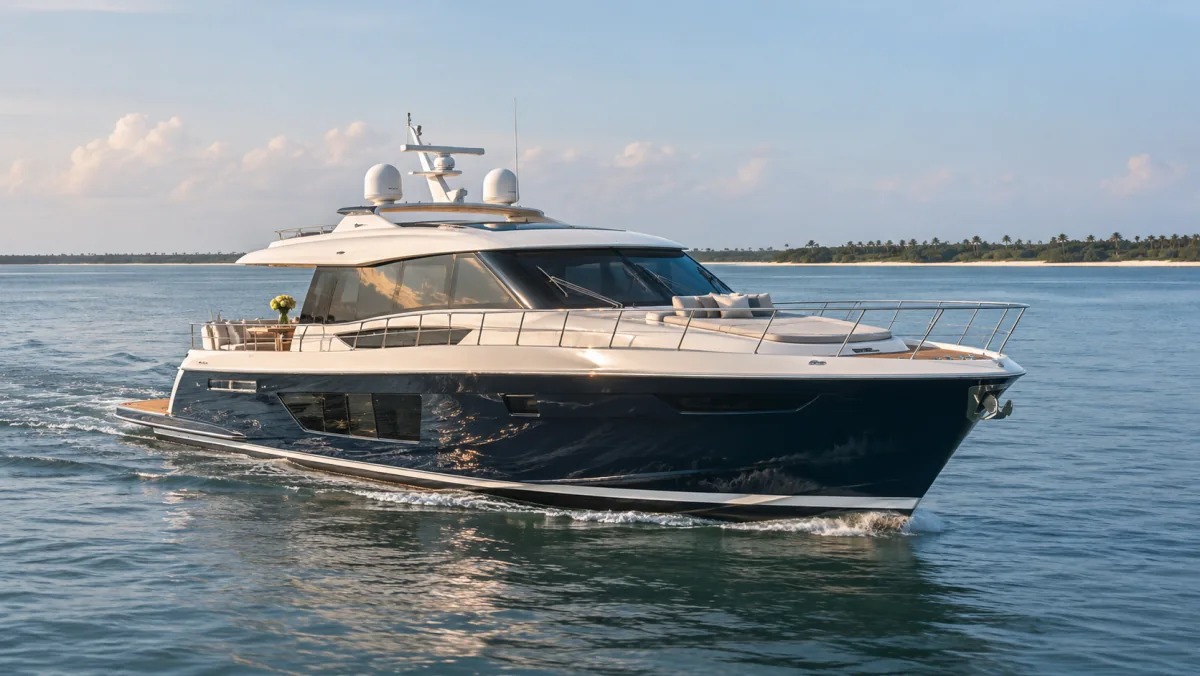
The ownership decision begins with the life you want aboard. Editorial illustration.
A morning in the Lowcountry, lunch off Palm Beach, a week in the Bahamas: the first picture of yacht ownership is usually a place you want to be. The next decision is how to get there.
Should you buy a new yacht, find an exceptional pre-owned vessel, or commission something around your own requirements? Each can be a satisfying route. The right choice depends on your cruising plans, the compromises you can accept, and how much time and attention you want to give the acquisition.
There is also an overlap in the language. A custom yacht is a new yacht when first delivered. Here, “new” means an available or ordered production model; “custom” means a project with a more individual design or specification. Those distinctions help explain the buying process, but the actual vessel and contract deserve closer attention than the category.
Begin by describing a normal month aboard. Who joins you? Where do you keep the yacht? How often do you stay overnight? Who operates it? A clear answer makes an attractive listing much easier to judge.
Buying a new yacht
The appeal of a new yacht is easy to understand. You choose a vessel at the beginning of its ownership history, often with contemporary equipment and an opportunity to shape the specification. How much you can choose depends on what has already been designed, ordered, and built.
Understand what is actually available
A completed stock yacht, a yacht already under construction, and a future production slot offer different levels of certainty. A completed vessel can be inspected as it stands. A project in progress may still allow selected changes. A future slot may provide more choice while placing greater weight on the written specification and delivery arrangements. Establish the status of the particular hull under discussion and ask which decisions remain open.
Ask for an itemized equipment list. Then walk through the yacht as though you were preparing for your first trip. Is the tender included? What about navigation equipment, stabilization, watermaking, linens, safety equipment, and spare parts? Which items are installed and tested, which remain allowances, and which are outside the price?
A long option list can obscure a simple question: does the finished specification support your intended use?
Treat handover as part of the purchase
Make room in the plan for commissioning, inspections, operating instruction, and initial use close to support. Ask your technical adviser what should be tested before acceptance, how unfinished items will be recorded, and who will resolve them. The agreement should make the responsibilities and timing clear.
During an inspection, look beyond the finishes. Ask to see how routine service points are reached, where manuals and system diagrams are stored, and how the owner or crew will learn the equipment. A well-organized handover has value long after the first impression fades.
Read the actual warranties before committing, checking the hull, machinery, and individual systems separately. Coverage can depend on the model, build location, and selling market; Sea Ray's published warranty information illustrates those distinctions. [2] Establish who handles a claim, what costs are excluded, and where authorized work can be performed. For an owner moving between the Carolinas, Florida, and the islands, the practical service arrangements deserve particular attention.
A new production yacht is worth exploring when an existing design already meets your important requirements and you prefer choosing within a defined range of options.
Buying a pre-owned yacht
A pre-owned yacht offers an immediate advantage: you can investigate the yacht that you would actually own. You can stand at the helm, walk through the cabins, inspect the machinery spaces, and compare the listing with the vessel itself.
It can also offer equipment, accommodations, or a level of finish that would fall outside the same budget when purchased new. Whether that represents good value depends on condition, required work, and the cost of operating the yacht you are considering.
Read the history behind the presentation
Ask for service records, invoices, available survey reports, equipment lists, and documentation of significant repairs or modifications. Try to establish what was done, when it was done, and who performed the work. A recent description saying “fully serviced” is less useful than records identifying the systems and work involved.
Discuss engine hours with the appropriate machinery specialist alongside maintenance history and patterns of use. Ask about extended periods out of service, previous damage, storage arrangements, and changes to major systems. An older yacht with a coherent history and well-planned maintenance may deserve more attention than a newer example with unanswered questions.
Treat an existing survey as background information. Commission an independent assessment suited to your purchase and the yacht's construction and systems. ABYC distinguishes a comprehensive prepurchase survey from a more limited survey prepared for insurance; the latter may not provide enough information for a buying decision. [3]
Agree the inspection scope in advance, including haul-out, underway testing, and specialist machinery checks where appropriate. California's Division of Boating and Waterways recommends independent survey and mechanical input and cautions that a survey cannot guarantee the absence of hidden defects. [4] Use the findings to understand the remaining uncertainty as well as the work identified.
Separate necessary work from personal improvements
Once inspection findings arrive, divide the proposed work into three groups: matters affecting safety or immediate operation, maintenance or repairs needed for your intended cruising, and changes made for personal preference. Obtain realistic estimates and yard availability before treating a refit as a simple adjustment to the purchase price.
New upholstery and updated electronics are different projects from changing a major machinery installation or moving structural elements. Ask qualified specialists to assess feasibility, access, weight, and system compatibility before assuming an existing yacht can be converted into the one you have in mind.
An appealing pre-owned purchase combines a suitable underlying design, a condition you understand, and a manageable path to use. The lowest asking price does not establish any of those things by itself.
Keep the transaction itself in view
Alongside condition, have the appropriate transaction and legal advisers review the seller's authority, ownership and registration records, outstanding mortgages or liens, and arrangements for their discharge where applicable. Clarify deposit custody, inspection access, acceptance deadlines, included inventory, and transfer of risk in the written agreement before committing funds. Allow time for the surveyors, insurer, and any lender to complete their work. Understanding the yacht and confirming the ability to transfer it are separate parts of a sound purchase.
Considering a custom or semi-custom yacht
Sometimes viewing existing yachts clarifies a recurring mismatch. The accommodation works, but the operating arrangement does not. The exterior spaces are right, but the tender cannot be handled as intended. The yacht meets your speed preference, but the rest of the cruising plan remains awkward.
That is a reason to investigate customization. It is also a reason to check whether your requirements conflict with one another before commissioning a design.
A semi-custom project generally retains an established platform while allowing changes within a defined scope. A more fully custom project can offer wider control over arrangement, engineering, and appearance. Builder terminology varies: Heesen, for example, distinguishes series, Smart Custom, and Full Custom approaches. [1] Ask which elements are fixed, which can change, and what each change would require.
Start with an owner's brief that explains the use of the yacht. Include cruising grounds, guests, operating arrangements, important destinations, tender requirements, and priorities for comfort. Let the design team test how those needs interact. A preference for shallow access, substantial accommodation, high speed, and long range needs an engineering discussion before it becomes a promise.
The project also needs a decision process. Who has authority to approve a change? Who assesses its technical consequences? How will changes affect price and delivery? What evidence will demonstrate that the agreed result has been achieved?
Discuss independent technical oversight and legal advice appropriate to the project. A broker, designer, builder, surveyor, and owner's representative may have different responsibilities; identify the appointed parties and their scope in writing. Have legal advisers review milestone payments, protections for funds advanced, delivery provisions, and responsibility for changes before committing. Do not assume that choosing a custom yacht automatically provides a complete owner's team.
Customization is most useful when it solves an important, clearly understood need and the owner is prepared for the decisions that follow. Our companion article, Your First Custom Yacht Brief, provides a practical starting worksheet.
Comparing the three paths
| Consideration | New production | Pre-owned | Custom or semi-custom |
|---|---|---|---|
| What you assess | A completed yacht or defined specification | The existing vessel and its history | A platform or design and the delivery process |
| Personal choices | Model options and remaining build flexibility | Changes feasible after purchase | Scope agreed with the project team |
| Principal uncertainty | Final specification and commissioning | Condition and required work | Design integration and project execution |
| Time to use | Availability plus handover preparation | Transaction plus necessary preparation | Design and construction plus commissioning |
| Essential discipline | Confirm what is included and tested | Investigate condition and price the work | Define requirements and control changes |
Individual yachts may differ substantially from these broad categories. Use the comparison to organize questions, then investigate the actual opportunity.
Compare the complete ownership commitment
Build a comparable budget for each serious candidate. Start with the acquisition price, then identify the expenses needed to reach the same point: a yacht ready for your intended cruising, in the location where you will use it.
That may include inspections, professional fees, applicable taxes and registration, delivery, commissioning, repairs, equipment, initial spares, and familiarization. Ask the relevant advisers which items apply to the transaction; an advertised price does not answer those questions.
Prepare a separate operating plan for dockage, insurance, maintenance, crew or professional assistance, fuel, utilities, and periodic work. Use the actual yacht, intended location, and operating pattern. A percentage of purchase price can conceal the difference between an older vessel needing substantial attention and a simpler yacht that suits your plans.
Keep an allowance for uncertainty that reflects the evidence available. Identify which figures are written quotations, which are estimates, and which remain unknown. Include the time the yacht will be unavailable while work is completed. A refit that occupies the season you hoped to enjoy has a cost beyond its invoices.
Consider your eventual sale, too. Ask how the layout, maintenance record, machinery, and proposed modifications might affect a future buyer's interest. Treat resale as a scenario to examine, with no assumed appreciation or guaranteed recovery of upgrade costs.
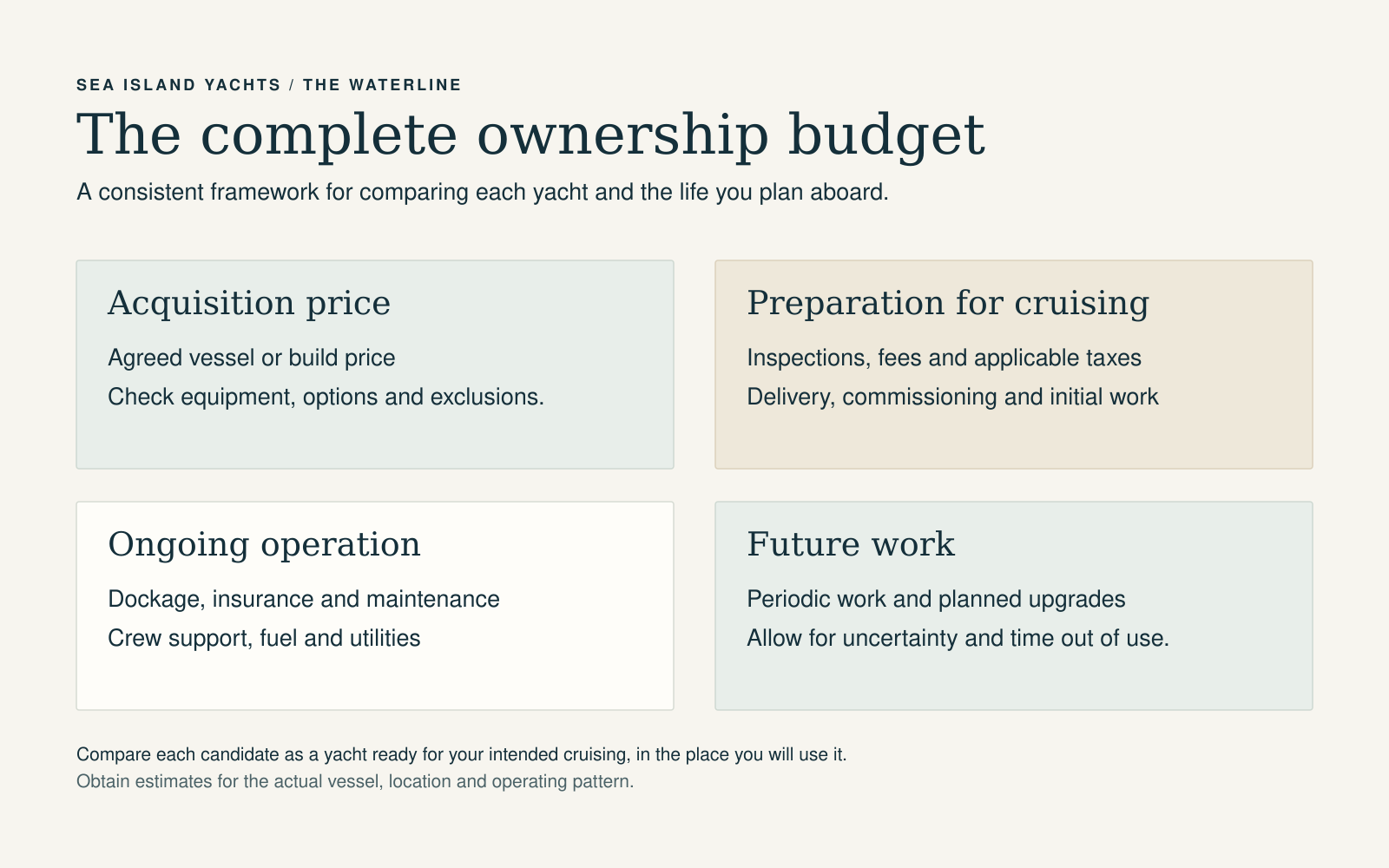
Compare acquisition, preparation, ongoing operation and future work for the actual yacht and intended use.
Three ways the answer can change
An owner with a fixed first season. Begin with completed yachts and a realistic path through inspections, closing, necessary work, and familiarization. Compare available new and pre-owned examples together. The useful date is when the yacht can be used as intended.
A family still learning its preferences. Spend time aboard several layouts and involve the people who will travel regularly. If practical, experience comparable yachts in use before making difficult-to-reverse design choices. An existing vessel may help clarify what a later custom project should achieve.
An owner with a specific operating requirement. Define the requirement precisely and test existing designs against it. If several otherwise suitable yachts share the same limitation, discuss whether an established platform can accommodate the change or whether a broader design exercise is justified.
These are illustrations of a decision process. They do not substitute for evaluating a particular yacht or project.
Make the shortlist useful
For each candidate, record the answers to the same questions:
- What will we do aboard during an ordinary week, and does this yacht support it?
- Which requirements are essential, and where would we accept a compromise?
- What is included, what must be added, and what work is still unpriced?
- What evidence supports condition, capability, and the expected delivery date?
- Can we obtain suitable berthing, insurance, service, and operating support?
- Who will operate and maintain the yacht, and what preparation will they need?
- What remains uncertain enough to change our decision?
Keep the last question visible. It helps the buying process move from impressions to evidence without losing sight of why you wanted a yacht in the first place.
Questions buyers often ask
Is a new yacht automatically easier to own?
Evaluate the actual systems, service arrangements, and handover. New equipment and warranty coverage can be valuable, while unfamiliar technology and commissioning issues can still require attention. Ask who will support the yacht where you intend to keep it.
Can an older yacht offer better value than a smaller new one?
It can, if its condition and ownership requirements fit your circumstances. Compare the work, operating demands, and use you will get from each. More space is valuable when you will enjoy it and are comfortable maintaining the vessel that provides it.
Do I need every answer before speaking with a broker?
No. Bring your cruising ideas, likely guests, approximate budget, and desired timing. Mark the areas you are uncertain about. An early conversation should help define a productive search and identify where specialist advice will be useful.
Begin with the life you want aboard
Speak with Sea Island Yachts about your next yacht. Bring your cruising plans, your likely guest group, and your preferred first season aboard. A clear picture of the ownership experience you want gives the search direction and a consistent basis for comparing each opportunity.
Sources and further reading
Sources checked November 4, 2026. Vessel specifications, agreements, and professional assessments govern the individual purchase.
- Heesen Yachts, build concepts and Smart Custom approach. https://www.heesenyachts.com/ and https://www.heesenyachts.com/heesen-smart-custom/
- Sea Ray, Boat Warranty Information, an example of model and market conditions. https://www.searay.com/us/en/owners/warranty
- American Boat and Yacht Council, Surveying a Boat. https://abycinc.org/recreational-boaters/surveying-a-boat/
- California Division of Boating and Waterways, How to Buy a Used Boat, inspection guidance. https://dbw.parks.ca.gov/?page_id=28974